


BS5839 fire alarm systems are used across commercial and residential buildings to ensure life safety and compliance with UK fire regulations.
On this page, we explain the different BS5839 categories (L1–P2), what they mean in practice, and the types of fire alarm equipment required — including control panels, detectors and manual call points.
BS5839 is the British standard for fire alarm systems, divided into BS5839-1 (Part 1, non-domestic) and BS5839-6 (Part 6, domestic). Below, you’ll find an overview of essential information to follow, however you must refer to the standard itself when installing devices. You can get a copy of the standard by visiting the BSI website.
BS5839-1 (Part 1)
Risk Assessment
The ‘Fire Precautions (Workplace) Regulations’ require any business employing five or more persons to hold a written ‘Fire Risk Assessment’ and ‘Emergency Plan’. This must be periodically reviewed.
The local fire brigade can enforce compliance, and close any building that does not meet this act.
In the event of a fire in a building without a written ‘Fire Risk Assessment’, those responsible may face fines and imprisonment, and/or private litigation.
What the law requires you to do:
- Complete a fire risk assessment for your workplace (considering all employees, the public, disabled people and people with special needs).
- Identify and record any significant findings or persons at risk.
- Provide and maintain fire precautions.
- Provide information, instruction and training.
- Nominate persons responsible to implement your emergency plan.
- Consult employees about the above nominations and your proposals to improve fire precautions.
- Inform other employees who may have work places in the building about any significant risks which may affect their safety and co-operate with them to reduce/control these risks.
- If you are not an employer, but control premises which contain more than one workplace, you are responsible for complying with fire regulations.
- You must establish a suitable means of contacting the emergency services.
- Your employees must cooperate to ensure the workplace is safe from fire and its effects.
System Zoning Information
In order to aid identification of the source of a possible fire, the protected building should be divided into ‘zones’. When deciding on a suitable zoning scheme for a building, consideration should be given to the size, any existing fire routines, escape routes, zone accessibility, and structural fire compartmentation.
The following guidelines should be observed:
If the total floor area of the building is less than 300m2 then the building needs only one zone, regardless of the number of storeys.
If the total floor area is greater than 300m2:
- The maximum area for a zone is 2000m2.
- If a stairwell (or similar) extends beyond one floor it should be a separate zone.
- If a zone covers more than one fire compartment then the zone boundaries should follow the compartment boundaries.
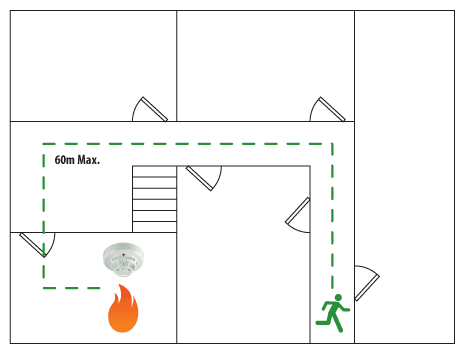
- The search distance within the zone in order to ascertain the position of the fire should not exceed 60m. Remember that the use of Remote Indicator lamps may help to reduce the distance travelled.
- If a building is divided between occupiers, zones must not be shared between them.
Manual Call Points
A ‘Manual Call Point’ is a device which enables personnel to raise an alarm in the event of a fire incident by pressing a frangible element to activate the alarm system.
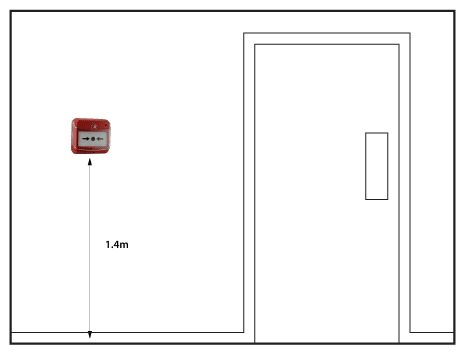
Manual Call Points should be installed at a height of 1.4m above floor level at easily accessible, conspicuous positions, on exit routes, at the entry floor landings of staircases and at all exits to the open air. They must be positioned on all floor exits, arranged to display at the Control and Indicating Equipment (CIE) within all floor zones, not stairway zones.
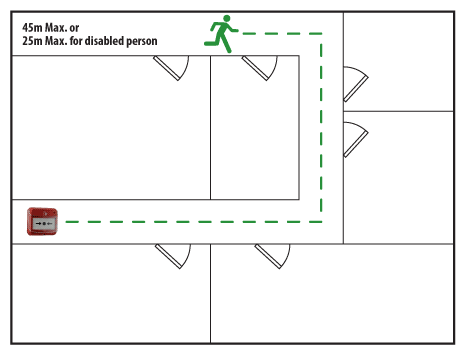
If a person is searching a Conventional Zone for a fire, they should need to travel 60m or less from the point of entry to find the fire. A person should have to travel 45m or less to reach a Manual Call Point, or 25m in areas with a higher fire risk. Those in wheelchairs should travel 25m or less to use a Manual Call Point.
Call points must be installed with a call point cover. If an existing call point has been fitted without a call point cover, it is advised to log this in your fire detection log book.
Automatic Detectors
When deciding on the type of detector to be used in any area it is important to remember that the detector has to discriminate between a genuine fire and the normal conditions existing therein.
Detector Information
Detection devices should not be sited within 1m from air inlets or forced ventilation systems (air-conditioning). Enclosed stairways should have a detector at the top of each stairway, and at each landing.
Smoke Detectors
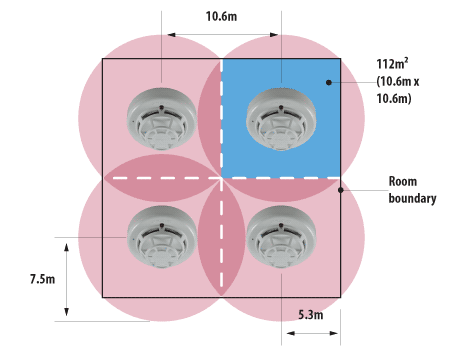
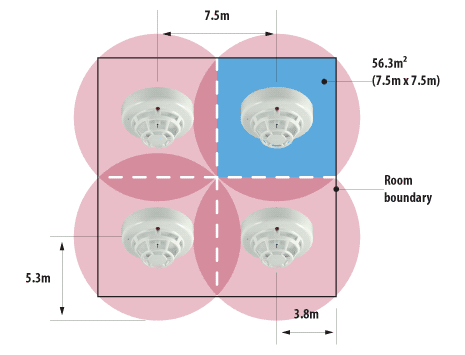
In open spaces under flat horizontal ceilings, every point should lie within 7.5m of a smoke detector.
Smoke detection should be generally avoided in the following areas to avoid unwanted alarms. They should be protected by means of other detectors such as heat detectors.
- Contamination in dusty areas may cause unwanted alarms and reduce the life of the detector.
- Damp or humid conditions such as showers, bathrooms and external areas should be avoided as the water vapour may cause unwanted alarms and reduce the life of the detector.
- Detectors should never be used at low temperatures where ice or condensation can affect detector sensitivity.
- Kitchens, garages, welding shops and boiler houses should generally be avoided.
In corridors less than 2m wide the horizontal spacing of smoke detectors may be increased, the areas of coverage need not overlap as in the case of a room.
Carbon Monoxide sensors can only be used in-conjunction with smoke sensors when in place in corridors.
Smoke detection devices have an individual coverage of 7.5m radius, which must overlap to ensure no “blind spots”.
Heat Detectors General
In open spaces under flat horizontal ceilings, every point should lie within 5.3m of a heat detector.
Heat detectors are designed to either detect a rapid rise in temperature or to operate at a fixed temperature. Heat detectors should not be set to temperatures less than 29°C above the average temperature, or less than 4°C above the highest temperature the device may experience.
Although heat detectors provide a slower response time than smoke detectors, they do provide a method of protection for areas where smoke detectors cannot be used.
Heat detectors should not be used for the protection of life or where extensive property loss may be expected, and should not be used in escape routes or corridors, unless covered by a variation.
Heat detection devices have an individual coverage of 5.3m radius, and again must overlap to ensure there are no “blind spots”. In corridors less than 2m wide the horizontal spacing of heat detectors may be increased, the areas of coverage need not overlap as in the case of a room.
‘Rate of Rise’ Heat Detectors
‘Rate of Rise’ heat detectors respond to both rapid increases of temperature and to fixed top temperatures.
‘Fixed Temperature’ Heat Detectors
Fixed temperature heat detectors are available with different temperature settings, and are normally installed in kitchens, boiler rooms, etc.
Detection In Apex Roofs
If the ceiling is pitched or sloping, smoke will tend to rise towards the highest point (apex) of the roof, therefore detection should be placed in the apex. As the slope tends to reduce the delay before smoke or heat reaches the detectors, it is permissible to use a greater spacing between the detectors mounted there.
Apex ceilings can be treated the same as flat ceilings as long as the height difference between the apex and eaves is less than 150mm for Heat detectors, or less than 600mm for Smoke detectors. If the apex ceiling is higher, detection devices should be installed at or near the apex.
Fire Alarm Sounders
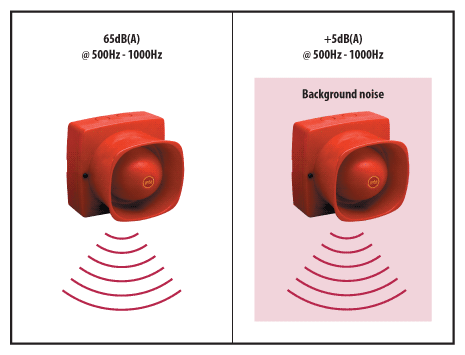
Fire Alarm Sounders should be installed throughout the building with an even distribution, to generally provide a minimum sound level of 65dB(A) or 5dB(A) above any background noise which is likely to persist for more than 30 seconds.
Alarm device circuits should be located so that if a single fault occurs, at least one sounder within the proximity of CIE will continue to operate.
In stairwells or enclosed areas smaller than 60m², excluding corridors, this requirement may be reduced to 60dB(A).
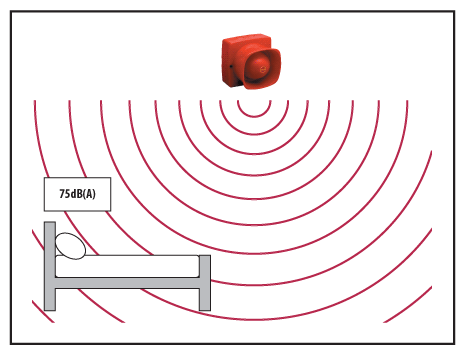
For environments where people are sleeping, sounders should produce a minimum of 75dB(A) at the bed-head with all doors closed. This will probably require a sounder within the room. Note that there will be a reduction in sound pressure through doors – 20dB(A) through a normal door, and 30dB(A) through a fire door.
All fire alarm sounders in a building should produce the same sound, distinct from any other audible warning devices in the building.
Where fire alarm sounders are required in extremely noisy areas e.g. machine shops, it may be necessary to install additional ‘Visual Alarm Detectors’ (VADs).
According to EN 54 Part 23, VADs should have light output:
- With 0.4 lumens per m2
- That does not wake sleeping people
- That is either red or white in colour
Strobes and beacons can be ceiling or wall mounted. VADs must be mounted above 2.1m from the finished floor level.
Cabling
The operation of a Fire Alarm and Detection System depends on the cabling and connections between the components. It is essential that connections between Manual Call Points and Detectors function correctly when they are operated.
Cables within the system are required to function correctly for significant periods after being attacked by fire. These include the power supply cables to the control panel, the detection circuits and the fire alarm sounder circuits. Thus the cables chosen must be correctly rated to withstand these conditions.
Fire cables below the height of 2m from floor level should be mechanically protected, using metal fixings. When cables pass through the floor, sleeving up to 300mm minimum should be fitted.
Cabling used for the Critical Signal Path and the final Low Voltage mains supply to any fire detection equipment must be fire resistant, in addition to being coloured externally in a single colour, such as red.
Low Voltage supply to all parts of the fire system must be equipped with a lockable isolation device.
Shop BS5839 Fire Alarm Equipment
Looking for compliant fire alarm equipment? Browse our core categories below: