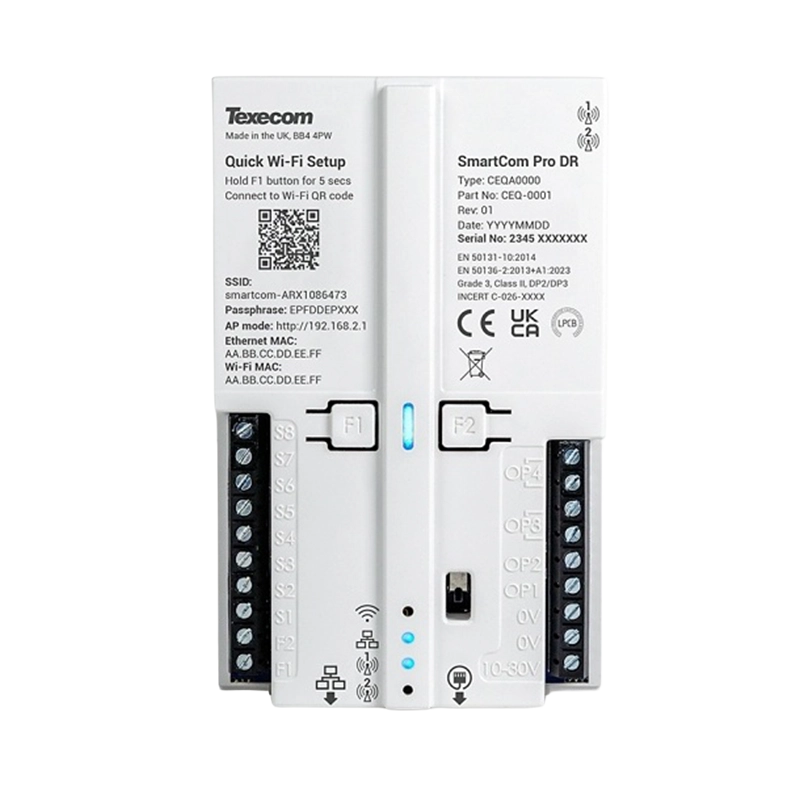
Texecom SmartCom Pro DR (CEQ-0001) | Dual Radio 4G Communicator | 2x Roaming eSIMs | Universal Compatibility
Summary
The Texecom SmartCom Pro DR represents the pinnacle of alarm communication resilience—a dual-radio 4G solution that doesn’t just provide backup connectivity, but actively selects and maintains connections across the two strongest available mobile networks simultaneously. For installers specifying systems where alarm monitoring must remain operational regardless of what fails—critical infrastructure, high-value assets, remote locations vulnerable to single-network coverage gaps—this communicator delivers the kind of redundancy that transforms potential liability into contractual confidence.
Unlike dual-path communicators that rely on broadband as primary and 4G as backup, the SmartCom Pro DR operates exclusively via 4G across two independent radio paths. The device features two separate modems with dual roaming SIMs from different mobile network operators—SIM 1 uses eUICC multi-profile technology enabling selection between Vodafone or Manx Telecom roaming profiles, whilst SIM 2 connects via Telefónica O2. This architecture means protection against single network operator failure, localised mast issues, and even MNO backbone problems. The communicator continuously monitors signal strength and intelligently selects the two best available networks for that specific location, providing genuine dual-radio redundancy that achieves DP2 or DP3 transmission categories under EN 50136.
Compatibility remains universal—any manufacturer’s intruder panel with digital outputs can benefit from this level of protection, whilst Texecom Premier Elite installations unlock the complete digital services ecosystem for remote management via Texecom Cloud. With two high-performance 4G antennas included and enhanced signal strength across all LTE bands, you can confidently quote the SmartCom Pro DR for challenging installations where single-path or even conventional dual-path solutions would leave you exposed. Designed and manufactured in Britain, this is the communicator you specify when “it just has to work” isn’t negotiable—and when your reputation depends on uninterrupted alarm monitoring.
Features
- Dual 4G radio communication operating simultaneously across two independent paths
- Intelligent network selection automatically chooses the two strongest available 4G networks
- Two separate modems with dual roaming SIMs from different mobile network operators
- SIM 1 features eUICC multi-profile technology enabling selection of Vodafone or Manx Telecom roaming profiles
- SIM 2 provides Telefónica O2 roaming connectivity as separate network path
- Triple-layer protection through multi-profile SIM technology effectively providing virtual backup SIMs
- Enhanced 4G connectivity across all LTE bands (B1, B3, B7, B8, B20, B28A) for reliable coverage
- Dual roaming eSIMs operate on Texecom’s private APN for enhanced data security
- Protection against mobile network operator backbone failures through separate MNO connections
- Achieves DP2 or DP3 transmission categories under EN 50136 for highest-grade compliance
- Works with any intruder panel featuring digital output trigger pins
- Note: Dual-path supported on dual radio only—Ethernet and Wi-Fi not available as signalling channels
- 10 configurable input pins enable tailored alarm configurations for diverse signalling requirements
- 4 configurable outputs (2 open collector, 2 relay) for keyswitch operation, ATP fault, ATS fault and tamper signalling
- Wide operating voltage range of 10-30V DC suitable for security and fire system integration
- Full serial compatibility with Texecom Premier Elite panels for enhanced functionality
- Remote health checks, configuration and fault diagnosis via Texecom Cloud
- Firmware upgrades delivered remotely through Texecom Cloud
- Annual connection and service billing management via Texecom Cloud
- AES 256 encryption protects alarm messages and polling communications
- Software anti-substitution protection guards against device replacement attacks
- EOL tamper-protected input link detects cable disconnection faults
- Four-step LED indication simplifies commissioning and troubleshooting
- Automatic connection to Texecom Cloud upon installation
- Local Wi-Fi access point mode for configuration (configuration only, not a signalling path)
- Environmental Class II rating for internal installation environments
- Two high-performance 4G antennas included with MMCX connectors
- Compact dimensions (75 x 120 x 26mm) for discreet installation
- Supplied with Premier Elite panel cable for proprietary serial connection
- Two-year manufacturer’s warranty
- Supported regions: UK, Europe, India and South Africa
FAQs
When should I specify the SmartCom Pro DR instead of the Pro 4G?
The SmartCom Pro DR is your answer when you’re working on installations where single points of failure are genuinely unacceptable—think critical infrastructure, pharmaceutical cold storage monitoring, valuable art collections, remote industrial sites, or any scenario where losing alarm monitoring connectivity could result in catastrophic consequences or contractual penalties. Whilst the Pro 4G provides excellent dual-path protection with broadband primary and 4G backup, the DR model eliminates dependence on the customer’s broadband entirely and protects against localised mobile network issues by maintaining simultaneous connections across two different operators. If the specification calls for DP2 or DP3 transmission categories, or if you’re working somewhere with patchy coverage from any single operator, the DR model is your only choice. Yes, it costs more, but for the right applications, it’s the difference between a system you can confidently warranty and one that keeps you awake at night.
How does the intelligent network selection actually work?
The SmartCom Pro DR continuously monitors signal strength across all available 4G networks in the location. Its dual modems independently assess which networks provide the strongest, most stable connections, then establish and maintain simultaneous connections across the two best performers. Crucially, because the two SIMs connect to different mobile network operators—one to Vodafone or Manx Telecom (selectable via the eUICC multi-profile), the other to Telefónica O2—you’re guaranteed diversity at the operator level, not just the mast level. If one network experiences congestion, an outage, or backbone issues, the other maintains the alarm signalling path completely independently. This isn’t sequential failover like the Pro 4G—both paths are active simultaneously, providing genuine dual-radio redundancy. You can monitor both connections’ status remotely through Texecom Cloud, giving you visibility into how the device is performing and whether any network is showing degradation that might need attention.
Why doesn’t the DR model support Ethernet or Wi-Fi signalling like the other models?
The SmartCom Pro DR is purpose-designed for dual-radio (4G/4G) communication to achieve DP2 and DP3 transmission categories, which specifically require two independent radio paths. Introducing Ethernet or Wi-Fi as signalling paths would change the architecture to dual-path (LAN/Radio) rather than dual-radio, which is what the Pro 4G already provides. The DR model exists for scenarios where you specifically need two completely independent cellular connections—remote locations without reliable broadband, installations where you can’t depend on customer-managed network infrastructure, or specifications that explicitly require dual-radio rather than dual-path compliance. The device does include Wi-Fi capability, but this is purely for configuration and diagnostics via the local access point mode, not for alarm signalling. If your installation has reliable broadband and you want to use that as primary with 4G backup, the Pro 4G is the appropriate choice. The DR model is for when 4G-only dual-radio redundancy is either required by specification or is simply the most reliable option for the location.
What are the power consumption implications of running two 4G modems?
The SmartCom Pro DR draws 130mA at 12V DC under typical operation—slightly higher than the Pro 4G’s 120mA but still very manageable within standard alarm panel power budgets. Peak consumption reaches 550mA when both modems are actively transmitting simultaneously, compared to 450mA for the Pro 4G. In practical terms, this means you need to factor in approximately 1.6 watts typical and 6.6 watts peak when calculating your overall system power requirements. For most professional alarm panels with decent power supplies, this presents no issues whatsoever—you’re talking about the equivalent power draw of adding a couple of PIR detectors. The modems spend most of their time in lower-power polling states rather than full transmission, so real-world consumption sits closer to the typical figure than the peak. That said, if you’re working on a particularly large system that’s already pushing the limits of the panel’s power supply, or if you’re retrofitting to an older panel with limited PSU capacity, just make sure you’ve got the headroom. The two included antennas draw no additional power—they’re purely passive.
Can I use the external antenna option (JAQ-0003) with just one modem, or do I need two external antennas?
You can use external antennas selectively based on your signal strength requirements. The SmartCom Pro DR comes with two high-performance antennas already included—one for each modem—which handle the vast majority of installations perfectly well. However, if you’re commissioning in a location where one or both networks show marginal signal strength, you can specify the optional external antenna (JAQ-0003) for either or both modems. The external antenna features a 10-metre cable, giving you the flexibility to position it optimally—perhaps higher up in the building, near a window, or in a different room entirely—to capture stronger signal. During commissioning, use Texecom Cloud to check the signal strength on both modems. If one shows full bars and the other is struggling, you might only need a single external antenna for the weaker path. If both are marginal, specify two external antennas. Remember that optimal antenna placement can make an enormous difference—sometimes just repositioning by a metre or moving to a different wall changes everything. The beauty of the 10-metre cable is it gives you options without having to relocate the entire communicator.
Are there any scenarios where dual 4G might provide worse coverage than a single 4G path?
No—the dual-radio architecture can only improve your position, never worsen it. The SmartCom Pro DR intelligently selects the two best available networks, so even if you’re in a location where only one operator provides decent coverage, the device will use that network for one path and select the next-best option (even if weaker) for the second path. You’re never in a worse position than having a single 4G communicator. Where the DR model truly excels is in locations where coverage is challenging but variable—perhaps one operator is strong indoors whilst another is better near windows, or where network congestion varies throughout the day. The intelligent selection means the device adapts to these conditions automatically. The only scenario where you might question the value is in locations with genuinely excellent coverage from multiple operators where any single path would be reliable anyway—but even then, you’re gaining protection against operator-specific outages, backbone failures, and network maintenance windows. The DR model is about eliminating single points of failure, and more connectivity options can never make reliability worse, only better.
How do I justify the additional cost of the DR model to customers?
Frame it around risk, compliance, and total cost of ownership rather than just the upfront price difference. Start by identifying what’s actually being protected—if it’s a £500,000 pharmaceutical cold store, a remote industrial facility where a monitoring failure could mean an undetected break-in causing hundreds of thousands in theft or damage, or a site where the specification mandates DP2/DP3 compliance, the cost differential becomes trivial compared to the consequences of failure. Explain that the DR model eliminates not just single network failure but operator-level failure—something that has happened during major outages—and that the dual modems provide genuine resilience that a broadband-primary system simply cannot match. For commercial contracts, emphasise that the higher transmission category can be a competitive differentiator in tender responses and demonstrates due diligence in system design. Calculate the cost over the system’s lifetime—perhaps £200-300 more upfront translates to £10-15 per year over a 20-year lifespan, which is negligible insurance for critical infrastructure. Finally, position it as your professional recommendation for their specific circumstances—your expertise is worth something, and customers who trust your judgement will understand that you’re specifying appropriately for their risk profile rather than just selling the most expensive option.
Can I monitor which networks the DR model is using and receive alerts if one path fails?
Absolutely—Texecom Cloud provides comprehensive visibility into both radio paths, showing you which mobile networks are currently connected, their signal strengths, data usage, and connection history. You can configure alerts to notify you if either path experiences degradation or failure, giving you the opportunity to address issues proactively rather than waiting for a customer complaint. This monitoring capability is invaluable for demonstrating system performance to customers, particularly on maintenance contracts where you’re providing ongoing monitoring services. If you notice one path consistently showing weaker signal than the other, you can schedule a service visit to optimise antenna placement or investigate whether there’s localised interference. For critical installations, you might set up automated monthly reports showing both paths’ performance statistics, giving customers documented evidence of the redundancy they’re paying for. This transparency builds trust and justifies premium service contracts—you’re not just installing and forgetting, you’re actively monitoring and managing their alarm communication infrastructure to ensure it performs as specified.
Specifications
- Part Code: CEQ-0001
- Transmission Category: DP2 or DP3
- Connectivity: Dual 4G radio (4G/4G dual radio only)
- LTE Bands: B1, B3, B7, B8, B20, B28A
- Encryption: AES 256 for alarm messages and polling
- Modem Configuration: 2 modems with dual roaming SIMs from separate network operators
- SIM 1 Technology: World OV eUICC multi-profile SIM enabling selection of Vodafone or Manx Telecom roaming profile
- SIM 2 Provider: Telefónica O2 roaming SIM
- Network Security: Texecom private APN with encrypted signalling
- Configuration Interface: Local Wi-Fi access point mode (configuration only, not a signalling channel)
- Input Pins: 10 configurable parallel interface inputs
- Outputs: 4 configurable (2 open collector, 2 relay)
- Operating Voltage: 10-30V DC
- Current Consumption (Typical): 130mA @ 12V DC
- Current Consumption (Peak): 550mA @ 12V DC
- Operating Temperature: 0°C to 40°C
- Relative Humidity: 0% to 95% non-condensing
- Environmental Class: Class II
- Module Dimensions: 75mm (W) x 120mm (H) x 26mm (D)
- Module Weight: 119g
- Case Dimensions: 126mm (W) x 180mm (H) x 35mm (D) (available separately, JAQ-0007)
- Case Weight: 200g (available separately, JAQ-0007)
- Compliance: PD 6669:2017, EN 50131-1:+A3:2020, EN 50131-10:2014, EN 50136-1:2012+A1:2018, EN 50136-2:2013+A1:2023
- Warranty: 2 years
- Included Accessories: 2 high-performance 4G antennas with MMCX connectors, Premier Elite panel cable for proprietary serial connection
- Supported Regions: 4G signalling available in UK, Europe, India and South Africa. Texecom Monitor available in UK, Belgium, Netherlands, Luxembourg
- Manufactured: Great Britain
Downloads
- Datasheet (Adobe PDF)
Additional information
| Device Type |
|---|
More Communicator products from Texecom
Texecom Premier Elite ComGSM
Texecom Premier Elite ComIP
Texecom SmartCom 4G
Texecom SmartCom Ethernet & WiFi Communicator
Texecom SmartCom Pro (CEN-0001) | Single Path Communicator | Ethernet & Wi-Fi | Universal Compatibility
Texecom SmartCom Pro 4G (CEP-0001) | Dual Path Communicator | Wi-Fi/LAN & 4G | Universal Compatibility