


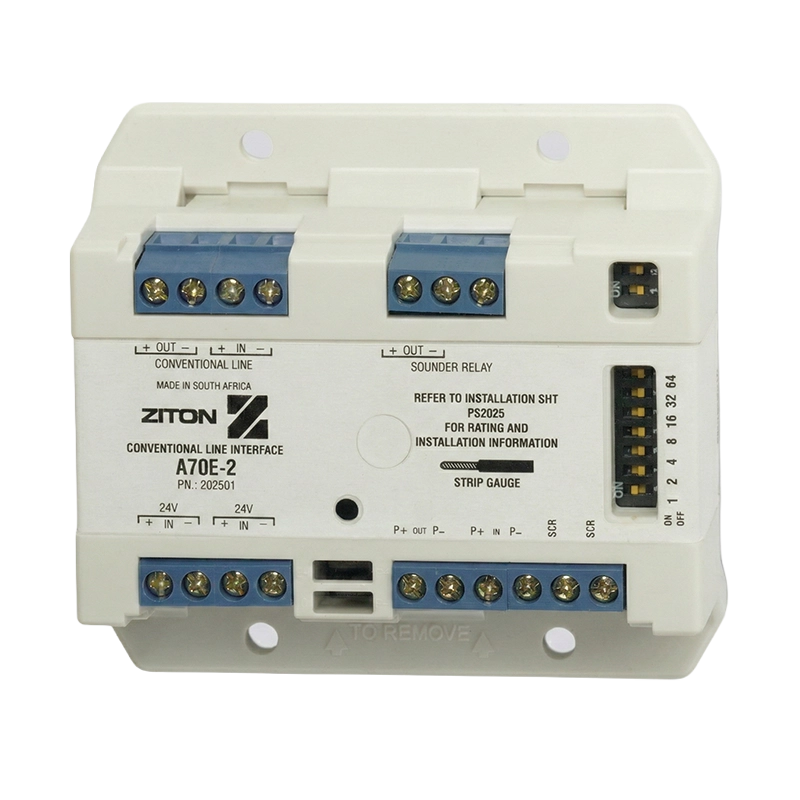
Ziton A70E-2 | Addressable Conventional Zone Interface | DIN Rail, Loop Powered
£90.86 (inc VAT: £109.03)
Summary
The Ziton A70E-2 Conventional Zone Interface Module provides a comprehensive interface between conventional detector zones and Ziton ZP addressable fire alarm systems. Enabling existing or new conventional fire detection zones to be integrated into addressable systems, each conventional zone appears as a single addressable device on the loop with its own unique address. This allows all areas of a site to be controlled and monitored by a single Ziton addressable fire panel while preserving investments in conventional detection equipment.
The module supports up to 32 Ziton or GST conventional devices (610, 620, 630 series) in normal or head-out modes, or up to 15 Hochiki intrinsically safe devices when configured for hazardous area applications. Zones are continuously monitored for alarm and fault conditions with status reported to the control panel every two seconds. The A70E-2 monitors conventional zone wiring for open circuit and short circuit faults via supplied end-of-line resistors (3.9kΩ for standard devices, 8.2kΩ for intrinsically safe devices), ensuring complete circuit supervision.
Key features include built-in head-out operation allowing detector removal monitoring when used with Z6-BS5 bases, dual power options (loop-powered at 18-20.5V pulsed or external 24VDC supply), and three selectable operating modes: Normal, Head-out, and Intrinsically Safe. Red and yellow LED indicators on the front panel provide clear visual confirmation of alarm and fault conditions respectively. Housed in a compact low-profile moulding (85 × 78 × 27mm), the module clips directly onto standard DIN35 rail or mounts in SMB-DIN1 or SMB-DIN2 surface boxes. With EN54-18 certification and CPR compliance, the A70E-2 provides a flexible, cost-effective solution for integrating conventional detection zones into modern addressable fire alarm systems.
Features
- Addressable interface module for connecting conventional detector zones to ZP addressable loops
- Compatible with Ziton ZP2 and ZP3 addressable fire alarm systems
- Each conventional zone assigned a unique addressable loop address (1-127)
- Supports up to 32 Ziton 610, 620, 630 series or GST DC-91 series conventional devices in normal/head-out modes
- Supports up to 15 Hochiki intrinsically safe devices in IS mode (requires GBX2000 galvanic isolator)
- Three selectable operating modes via DIP switch: Normal, Head-out, and Intrinsically Safe
- Normal mode: standard conventional detector operation with open and short circuit monitoring
- Head-out mode: detector removal monitoring with Z6x0-3 detectors and Z6-BS5 bases with Schottky diode
- Intrinsically Safe mode: interface for hazardous area detectors using 8.2kΩ EOL resistor
- Status reporting to control panel every 2 seconds for rapid alarm and fault indication
- Continuous monitoring of conventional zone wiring for open and short circuit faults
- Supplied with end-of-line resistors: 3.9kΩ for standard devices, 8.2kΩ for IS devices
- Manual call point support with 470Ω or 680Ω resistor
- Built-in head-out operation maintains zone operation when detector removed from base
- Detector removal monitoring requires Z6-BS5 bases with series Schottky diode
- Dual power options: loop-powered (18-20.5V pulsed) or external supply (19-30VDC)
- Low current consumption: 8.3mA quiescent loop-powered, 7.3mA quiescent externally powered
- Alarm current: 24.6mA maximum loop-powered, 36.6mA maximum externally powered
- Seven-segment DIP switch for binary address configuration from 1 to 127
- Jumper J1 for power source selection (loop power or external 24VDC)
- Two-way mode DIP switch for operating mode selection
- Red LED indicator flashes to show conventional zone fire alarm condition
- Yellow LED indicator flashes to show conventional zone fault condition
- Yellow LED double-flashes to indicate power supply fault
- Alarm LED output maintained by panel until reset
- Fault LED is non-latching for immediate fault status indication
- Compatible with devices operating at 12.5-20VDC (normal/head-out) or 14-20VDC (IS mode)
- Alarm clamp voltage: 3-9V for connected devices
- Automatic 2.4 second power disconnect reset supplied to connected devices
- Additional output available to switch external 24VDC in alarm conditions
- Suitable for interfacing linear beam detectors and magnetic door retainers (via interposing relay)
- Low profile white moulded ABS housing: 85mm wide × 78mm high × 27mm deep
- Weight: 80g for easy handling and installation
- DIN35 rail mounting or surface mounting in SMB-DIN1/SMB-DIN2 enclosures
- Shielded twisted-pair wiring for addressable loop, two-core for conventional zone
- Operating temperature range: -10°C to +55°C (some sources indicate up to +80°C)
- Storage temperature range: -10°C to +55°C
- Relative humidity: 20% to 95% non-condensing
- Suitable for indoor and intrinsically safe environments
- IP20 environmental protection rating
- EN54-18:2005 certified for input/output devices in fire detection systems
- CPR (Construction Products Regulation) compliant
- No user-serviceable parts, sealed maintenance-free unit
- Up to 127 interface modules can be installed per ZP loop (with external PSU)
- Enables cost-effective integration of conventional zones into addressable systems
FAQs
How many conventional detectors can be connected to the A70E-2?
The A70E-2 can support different quantities depending on the operating mode and detector type. In Normal or Head-out operating modes, up to 32 Ziton 610, 620, 630 series detectors or GST DC-91 series conventional devices can be connected to a single interface module. In Intrinsically Safe mode for hazardous area applications, up to 15 Hochiki IS devices can be connected (requiring a GBX2000 galvanic isolator). The module appears as a single addressable device on the loop regardless of how many conventional detectors are connected to it.
What are the three operating modes and when should each be used?
The A70E-2 offers three operating modes selectable via the Mode DIP switch. Normal mode (SW1 and SW2 OFF) provides standard conventional detector operation with open and short circuit monitoring using a 3.9kΩ EOL resistor – this is the most common configuration for standard conventional zones. Head-out mode (SW1 OFF, SW2 ON) enables detector removal monitoring when using Z6x0-3 detectors with Z6-BS5 bases containing a Schottky diode, maintaining operation of other zone devices when a detector is removed. Intrinsically Safe mode (SW1 ON or both SW1 and SW2 ON) interfaces with certified IS detectors for hazardous areas using an 8.2kΩ EOL resistor. Note that it’s not possible to operate in both IS and head-out mode simultaneously.
Can the A70E-2 be powered directly from the loop?
Yes, the A70E-2 is fully loop-powered as standard, drawing its operating power directly from the ZP addressable loop at 18-20.5V pulsed. Loop-powered operation consumes 8.3mA quiescent and up to 24.6mA in alarm conditions. However, in systems where numerous interface modules are installed or current requirements are excessive, the A70E-2 can alternatively be powered from an external EN54-4 compliant 24VDC power supply (19-30VDC). External power selection is configured using jumper J1. When externally powered, the module draws 7.3mA quiescent and up to 36.6mA in alarm from the external supply, with only 1.5mA drawn from the loop.
How does head-out detection work?
Head-out detection allows the A70E-2 to monitor when a detector is removed from its base while maintaining operation of all other devices in the zone. This requires Z6x0-3 series detectors installed on Z6-BS5 bases that include a series Schottky diode, or other detectors with a series supply diode fitted to the base. When configured in head-out mode (Mode DIP switch: SW1 OFF, SW2 ON) and using a 3K9 resistor, the interface monitors the circuit configuration to detect head removal. This is valuable for maintenance purposes as it alerts the system when a detector has been removed without disabling the entire zone.
What is the difference between the 3.9kΩ and 8.2kΩ end-of-line resistors?
The A70E-2 uses different end-of-line (EOL) resistor values depending on the type of devices connected and the operating mode. The 3.9kΩ (3K9) EOL resistor is used with standard conventional devices in Normal and Head-out operating modes – this is supplied with the unit and provides open and short circuit fault monitoring for typical conventional detector zones. The 8.2kΩ (8K2) EOL resistor is specifically required when operating in Intrinsically Safe mode with certified IS detectors for hazardous area applications. The different resistance values enable the module to correctly monitor circuit integrity for the specific electrical characteristics of standard versus intrinsically safe detection equipment.
How is the address set on the A70E-2?
The A70E-2 uses a seven-segment DIP switch for address configuration using binary coding. Each switch has a decimal value: switch 1 = 1, switch 2 = 2, switch 3 = 4, switch 4 = 8, switch 5 = 16, switch 6 = 32, and switch 7 = 64. The device address is calculated by adding the values of all switches set to ON. For example, to set address 007, switches 1, 2, and 3 should be ON (1 + 2 + 4 = 7) with all other switches OFF. This allows any address from 1 to 127 to be configured, with each conventional zone taking one addressable loop address.
What do the LED indicators show?
The A70E-2 features two LED indicators for status monitoring. The red Alarm LED flashes when the conventional zone is in fire alarm condition – once registered by the panel, this alarm output is maintained until the system is reset. The yellow Fault LED flashes when the conventional zone has a fault condition (open or short circuit wiring fault), and this LED is non-latching so it immediately reflects current fault status. Additionally, the yellow Fault LED will double-flash to indicate a power supply fault, such as when jumper J1 is left out or when external power is removed while J1 is set to the external power position.
Can multiple A70E-2 modules be used on the same loop?
Yes, multiple A70E-2 modules can be installed on the same ZP addressable loop. The Ziton protocol supports up to 127 addressable devices per loop, which can include detectors, manual call points, and interface modules. With external power supplies, up to 127 conventional zone interface modules could theoretically be installed on a single loop, each monitoring its own conventional detector zone with a unique address. This enables large conventional fire alarm systems to be integrated into a single addressable control panel, providing centralized monitoring and control of all conventional zones throughout a facility.
Specifications
- Product Code: A70E-2 (202501-101)
- Type: Conventional zone interface module for addressable systems
- Compatibility: Ziton ZP2 and ZP3 addressable fire alarm systems
- Certification: EN54-18:2005, CPR certified
- Operating Voltage (Loop Powered): 18 to 20.5V pulsed
- Operating Voltage (External Power): 19 to 30 VDC
- Current Consumption (Loop Powered): 8.3mA quiescent (RMS), 24.6mA alarm maximum
- Current Consumption (Externally Powered): Loop 1.5mA, External supply 7.3mA quiescent, 36.6mA alarm maximum (external), 24mA worst case short circuit fault
- Full Load Additional Current: Add 1.5mA in Normal/Head-out modes or 3mA in Intrinsically Safe mode
- Conventional Zone Capacity (Normal/Head-out): Maximum 32 Ziton 610, 620, 630 series or GST DC-91 series devices
- Conventional Zone Capacity (Intrinsically Safe): Maximum 15 Hochiki IS devices (requires GBX2000 galvanic isolator)
- Operating Modes: Normal, Head-out, Intrinsically Safe (selectable via DIP switch)
- Status Reporting Interval: Every 2 seconds to control panel
- Conventional Zone Monitoring: Open and short circuit fault with EOL resistor
- End Of Line Resistor (Standard Devices): 3.9kΩ (3K9)
- End Of Line Resistor (IS Devices): 8.2kΩ (8K2)
- Head-out Resistor: 3K9 (requires Z6x0-3 detectors with Z6-BS5 bases)
- Manual Call Point Resistor: 470Ω or 680Ω
- Compatible Device Operating Voltage (Normal/Head-out): 12.5 to 20 VDC
- Compatible Device Operating Voltage (Intrinsically Safe): 14 to 20 VDC
- Alarm Clamp Voltage: 3 to 9V
- Reset Function: 2.4 second power disconnect supplied by A70E-2
- Addressing Method: 7-segment DIP switch (binary coding)
- Address Range: 1 to 127
- Power Source Selection: Jumper J1 (loop power or external 24VDC)
- Status Indication (Alarm): Red LED, flashing when conventional zone in fire alarm
- Status Indication (Fault): Yellow LED, flashing for zone fault, double-flashing for power fault
- Alarm LED Latching: Maintained by panel until reset
- Fault LED Latching: Non-latching (immediate status indication)
- Wiring (Addressable Loop): Two-core shielded twisted-pair
- Wiring (Conventional Zone): Two-core
- Mounting Type: DIN35 rail or surface mount (SMB-DIN1/SMB-DIN2 enclosures)
- Material: Moulded ABS
- Colour: White
- Dimensions (W × H × D): 85 × 78 × 27mm
- Weight: 80g
- Operating Temperature: -10°C to +55°C (some sources indicate up to +80°C)
- Storage Temperature: -10°C to +55°C
- Relative Humidity: 20% to 95% non-condensing
- Environment: Indoor, intrinsically safe (IS mode)
- IP Rating: IP20
- User Serviceable Parts: None – do not disassemble
- Maximum Modules Per Loop: Up to 127 conventional zone interfaces (with external PSU)
- Compatible Mounting Boxes: SMB-DIN1 (1-unit capacity), SMB-DIN2 (2-unit capacity)
- Manufacturer: KGS Safety System (Hebei) Co. Ltd., China
- EU Representative: KGS Fire & Security B.V., Netherlands
- Notified Body: 0370
- Declaration Of Performance Number: 360-5211-0399
- Year Of First CE Marking: 2010
- EN 54 Standard: EN 54-18
Downloads
- Datasheet (Adobe PDF)
- Installation Manual (Adobe PDF)
Additional information
| Protocol |
|---|