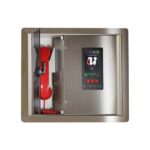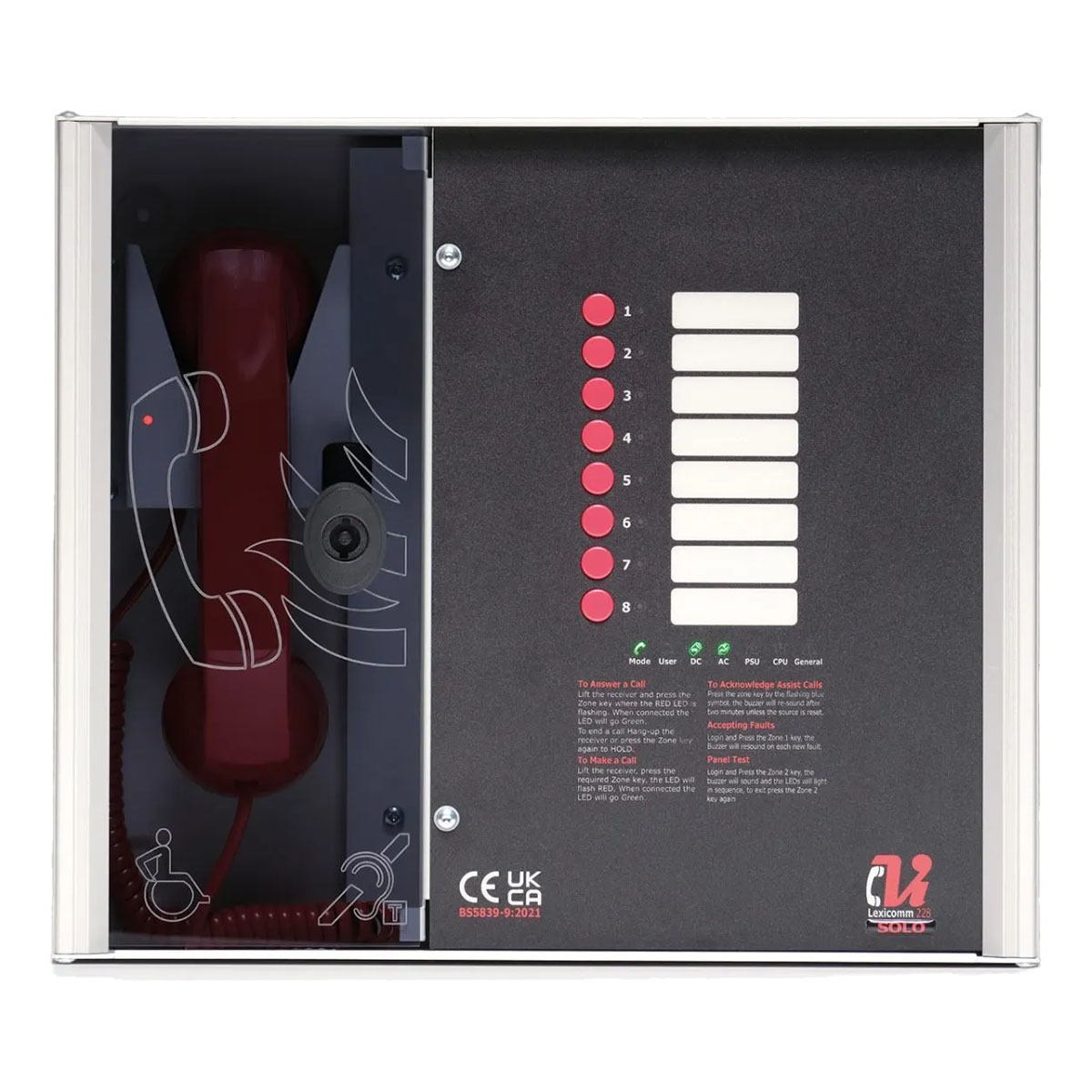
Lexicomm 2-8 Line Networked EVC Master Station
Summary
The LexiComm 2 to 8 Line Master Station ViLX-228N is a sophisticated emergency voice communication system designed to comply with BS 5839-9:2021. It is ideal for high-rise buildings or large sites where radio communication may be unreliable due to interference from fire plasma. The ViLX-228N is designed for use as a fire telephone system, disabled refuge system, or a combined system, providing a secure, bi-directional, full duplex voice communication solution.
This master station is repeater compatible, allowing for integration into a network with up to 8 lines. It offers a simple setup without the need for software and includes features such as integrated Assist Call with acknowledge, a 1.2A integral PSU, and a lockable handset cover. The ViLX-228N is expandable and can be wall-mounted, making it versatile for various installation needs.
Key Features
- Simple set up, no software
- Repeater compatible
- Fully compliant to BS 5839-9:2021
- Integrated Assist Call with acknowledge meeting BS 8300
- 1.2A integral PSU
- Full duplex operation
- Wall mount enclosure
- Lockable handset cover
- Expandable from 2 to 8 lines
- Inbuilt networking
FAQ
What is an Emergency Voice Communication System (EVCS)?
An Emergency Voice Communication System (EVCS) is a fixed, secure, bi-directional, full duplex voice communication system that assists fire fighters during emergencies in high rise buildings or large sites where radio communication cannot be guaranteed to work due to interference from fire plasma. It allows voice communication between a central control point and multiple outstation points throughout a building.
When is an EVCS system required?
EVCS systems are generally required in the following situations:
• In any building or sports venue where there are disabled people, or people who may have difficulty negotiating the evacuation route
• In buildings with phased evacuation and/or firefighting lifts where it facilitates secure communications for building managers, fire wardens, and attending fire officers
• At sports venues and similar complexes, where it will assist stewards in controlling the evacuation of the area in an emergency
Fire telephone systems are recommended for all public buildings and multi-story buildings over four floors by BS9999. Disabled Refuge systems are required in buildings where the public or disabled staff gains access to any floor other than the ground floor using lifts.
How many lines can the ViLX-228N Master Station support?
The ViLX-228N Master Station can support between 2 to 8 lines, expandable in 2-line blocks using dual line cards. Each line can connect to one outstation (Type A, Type B, Type C, jack point, or Assist Call system). The system can also be networked with a repeater station to share the 8 lines across two panels.
What types of outstations are compatible with the system?
The ViLX-228N is compatible with the full range of Lexicomm outstations including:
• Type A outstations (fire telephone with handset)
• Type B outstations (hands-free refuge points)
• Type C outstations (combined Type A and Type B)
• Jack points for roaming phones
• Assist Call emergency assistance alarms
What are the power and battery requirements?
Each ViLX-228N Master Station requires:
• AC Input: 230V AC ± 10% 50/60Hz
• Local isolation with a B6A breaker clearly marked “EMERGENCY VOICE COMMUNICATION SYSTEM. DO NOT TURN OFF”
• One 12V 7AH valve regulated sealed lead acid battery (not supplied)
• Battery backup for 24 hours standby and 3 hours operation as required by BS 5839-9:2021
What cable types are required for installation?
Cable requirements depend on the system type:
• Fire telephone systems (Type A): Enhanced grade fire resistant cabling throughout, including mains supply
• Disabled refuge systems (Type B): Standard grade fire resistant cable for buildings under 30m or with sprinklers; enhanced grade for buildings over 30m without sprinklers
• Combined systems: Enhanced grade for shared cables and Type A connections; standard grade acceptable for individual Type B spurs
• Maximum distance: 500m using 1mm or 1.5mm cable from outstation to master station
How do you receive and make calls on the system?
To receive a call: One of the zone LEDs and mode LED will flash red. Lift the master handset (User LED illuminates red), then press the corresponding zone button. The LED changes to flashing green indicating the call is connected.
To make a call: Lift the master handset (User LED illuminates red), press the zone button for the required outstation. The zone LED will flash red, and when the outstation answers, it changes to flashing green.
How do you acknowledge Assist Call alarms?
When an Assist Call alarm is activated, the appropriate zone LED will flash blue and a two-tone buzzer sounds. To acknowledge the alarm, press the corresponding zone button. The blue LED will illuminate continuously with an intermittent buzzer tone every 15 seconds. If the alarm is not cancelled within 2 minutes, the buzzer will resound and the LED will flash blue again.
What maintenance is required for the EVCS?
BS 5839-9:2021 requires a maintenance agreement with the following schedule:
• Weekly: Test a different outstation each week until all are tested, record results in site log
• Biannually: Engineer call to check system operation, intelligibility, and battery health
• Yearly: Engineer call for 100% outstation and master station operation testing
• 5 Yearly: Replace all batteries and record in log book
What standards does the ViLX-228N comply with?
The ViLX-228N Emergency Voice Communications System is designed to fully comply with:
• BS 5839-9:2021 (Fire detection and fire alarm systems)
• BS 9999:2017 (Fire safety in the design, management and use of buildings)
• BS 8300-2:2018 (Design of an accessible and inclusive built environment)
• EN IEC62368-1:2020+A11:2020 (Low Voltage Directive)
• EMC compliance: EN 55035:2017+A11:2020 and EN 55032:2015+A1:2020
Can the system be networked with other panels?
Yes, the ViLX-228N has built-in networking capability. It can form a small network of 2 panels with lines split as 8-0, 6-2, or 4-4 ratio (maximum 8 lines total). It can also form part of a larger Lexicomm network on campus-style sites when used with a Touchscreen Master Station (ViLX-TMS-W-8) as the site master.
What should I do if there are faults on the system?
Before accepting faults, note the fault in the logbook along with the time reported. To accept the fault, enter access level 2 (code: 1664) or access level 3 (code: 1812), then press zone button 1. The buzzer will silence and the general fault LED will go steady. Press zone button 8 to exit the menu. The buzzer will resound on each new fault.
How do I access the configuration menus?
The system has two access levels:
• Access level 2 (User): Enter code 1664 using zone buttons 1-8
• Access level 3 (Engineer): Enter code 1812 using zone buttons 1-8
When the correct code is entered, LEDs 1-3 illuminate cyan for User mode, or LEDs 1-5 illuminate cyan for Engineer mode.
RetryTuse ul tags in answer where requiredEditTransformed bullet points to HTML list tags1sThe user wants me to convert the bullet points in the answers to use HTML
- and
- tags instead of the bullet characters. Let me go through and update the relevant answers.html
What is an Emergency Voice Communication System (EVCS)?
An Emergency Voice Communication System (EVCS) is a fixed, secure, bi-directional, full duplex voice communication system that assists fire fighters during emergencies in high rise buildings or large sites where radio communication cannot be guaranteed to work due to interference from fire plasma. It allows voice communication between a central control point and multiple outstation points throughout a building.
When is an EVCS system required?
EVCS systems are generally required in the following situations:
- In any building or sports venue where there are disabled people, or people who may have difficulty negotiating the evacuation route
- In buildings with phased evacuation and/or firefighting lifts where it facilitates secure communications for building managers, fire wardens, and attending fire officers
- At sports venues and similar complexes, where it will assist stewards in controlling the evacuation of the area in an emergency
Fire telephone systems are recommended for all public buildings and multi-story buildings over four floors by BS9999. Disabled Refuge systems are required in buildings where the public or disabled staff gains access to any floor other than the ground floor using lifts.
How many lines can the ViLX-228N Master Station support?
The ViLX-228N Master Station can support between 2 to 8 lines, expandable in 2-line blocks using dual line cards. Each line can connect to one outstation (Type A, Type B, Type C, jack point, or Assist Call system). The system can also be networked with a repeater station to share the 8 lines across two panels.
What types of outstations are compatible with the system?
The ViLX-228N is compatible with the full range of Lexicomm outstations including:
- Type A outstations (fire telephone with handset)
- Type B outstations (hands-free refuge points)
- Type C outstations (combined Type A and Type B)
- Jack points for roaming phones
- Assist Call emergency assistance alarms
What are the power and battery requirements?
Each ViLX-228N Master Station requires:
- AC Input: 230V AC ± 10% 50/60Hz
- Local isolation with a B6A breaker clearly marked “EMERGENCY VOICE COMMUNICATION SYSTEM. DO NOT TURN OFF”
- One 12V 7AH valve regulated sealed lead acid battery (not supplied)
- Battery backup for 24 hours standby and 3 hours operation as required by BS 5839-9:2021
What cable types are required for installation?
Cable requirements depend on the system type:
- Fire telephone systems (Type A): Enhanced grade fire resistant cabling throughout, including mains supply
- Disabled refuge systems (Type B): Standard grade fire resistant cable for buildings under 30m or with sprinklers; enhanced grade for buildings over 30m without sprinklers
- Combined systems: Enhanced grade for shared cables and Type A connections; standard grade acceptable for individual Type B spurs
- Maximum distance: 500m using 1mm or 1.5mm cable from outstation to master station
How do you receive and make calls on the system?
To receive a call: One of the zone LEDs and mode LED will flash red. Lift the master handset (User LED illuminates red), then press the corresponding zone button. The LED changes to flashing green indicating the call is connected.
To make a call: Lift the master handset (User LED illuminates red), press the zone button for the required outstation. The zone LED will flash red, and when the outstation answers, it changes to flashing green.
How do you acknowledge Assist Call alarms?
When an Assist Call alarm is activated, the appropriate zone LED will flash blue and a two-tone buzzer sounds. To acknowledge the alarm, press the corresponding zone button. The blue LED will illuminate continuously with an intermittent buzzer tone every 15 seconds. If the alarm is not cancelled within 2 minutes, the buzzer will resound and the LED will flash blue again.
What maintenance is required for the EVCS?
BS 5839-9:2021 requires a maintenance agreement with the following schedule:
- Weekly: Test a different outstation each week until all are tested, record results in site log
- Biannually: Engineer call to check system operation, intelligibility, and battery health
- Yearly: Engineer call for 100% outstation and master station operation testing
- 5 Yearly: Replace all batteries and record in log book
What standards does the ViLX-228N comply with?
The ViLX-228N Emergency Voice Communications System is designed to fully comply with:
- BS 5839-9:2021 (Fire detection and fire alarm systems)
- BS 9999:2017 (Fire safety in the design, management and use of buildings)
- BS 8300-2:2018 (Design of an accessible and inclusive built environment)
- EN IEC62368-1:2020+A11:2020 (Low Voltage Directive)
- EMC compliance: EN 55035:2017+A11:2020 and EN 55032:2015+A1:2020
Can the system be networked with other panels?
Yes, the ViLX-228N has built-in networking capability. It can form a small network of 2 panels with lines split as 8-0, 6-2, or 4-4 ratio (maximum 8 lines total). It can also form part of a larger Lexicomm network on campus-style sites when used with a Touchscreen Master Station (ViLX-TMS-W-8) as the site master.
What should I do if there are faults on the system?
Before accepting faults, note the fault in the logbook along with the time reported. To accept the fault, enter access level 2 (code: 1664) or access level 3 (code: 1812), then press zone button 1. The buzzer will silence and the general fault LED will go steady. Press zone button 8 to exit the menu. The buzzer will resound on each new fault.
How do I access the configuration menus?
The system has two access levels:
- Access level 2 (User): Enter code 1664 using zone buttons 1-8
- Access level 3 (Engineer): Enter code 1812 using zone buttons 1-8
When the correct code is entered, LEDs 1-3 illuminate cyan for User mode, or LEDs 1-5 illuminate cyan for Engineer mode.
What safety precautions should be followed during installation?
Important safety requirements include:
- Equipment must only be installed and maintained by suitably skilled and competent persons
- The unit must be earthed (Class 1 equipment per EN IEC62368-1:2020+A11:2020)
- Indoor use only – do not expose to rain or moisture
- No user serviceable parts inside
- Take anti-static precautions when handling PCBs
- Always apply mains power before connecting batteries
- Connect positive (red) battery terminal first, disconnect negative (black) terminal first
What is the maximum cable distance and what end-of-line components are needed?
The maximum cable distance is 500m from the master station to outstations using 1mm or 1.5mm cable. Each line requires a 10kΩ end-of-line (EOL) resistor:
- For Type A, Type B, and Type C outstations: EOL resistor connects to the end-of-line terminal in the outstation
- For Jack points and Assist Call systems: EOL resistor connects to the last device on the line
- Two EOL resistors are supplied per line card in the accessory pack
How do conference calls work on the system?
The ViLX-228N Master Station supports conference calling with the following features:
- Up to 8 lines can be connected to a conference call (depending on line cards fitted)
- The master station controls which lines are involved in the conference
- Only one conference group is allowed at a time
- Follow normal procedures to receive/make calls to individual outstations
- All connected lines can communicate with each other simultaneously
Specifications
- Power Supply and Charger : 230VAC +/- 10% 50/60Hz
- Internal Supply : 5V, 16V, 27V DC
- Battery Type</strong >: 1 x 12V 7AH VRSLA
- Mains Fuse : 240V 1A HRC
- Battery Fuse : 750mA PTC
- Charge Current : 400mA
- Dimensions : Height 300mm, Width 350mm, Depth 95mm
- Weight : 4.2kg
- Standards Compliance : EMC EN 55035:2017+A11:2020, EN 55032:2015+A1:2020, LVD EN IEC62368-1:2020+A11:2020, BS 5839-9:2021, BS 9999:2017, BS 8300-2:2018
- Part Numbers : 0 Line Master Station ViLX-228N-0, 2 Line Master Station ViLX-228N-2, 4 Line Master Station ViLX-228N-4, 8 Line Master Station ViLX-228N-8
Downloads
- Datasheet (Adobe PDF)
- Quick Start Guide (Adobe PDF)
- User Guide (Adobe PDF)
- Manual (Adobe PDF)